
Gas Flaring In Ebedei Community: Emblematic of Niger Delta Plight

By Nosa Tokunbo Esq, Executive Director, Foundation for Earth Rights Assembly -FERA
28/08/2025
www.fera.ng
In the oil-rich Niger Delta region of Nigeria, communities have had to groan under the bourgeoning burning gas flares for decades. Countries with significant oil production and exploration activities tend to have higher gas flaring. Flaring, the process of burning off natural gas during oil extraction has been a persistent challenge for oil and gas companies ever since oil production began in Nigeria.
More so, in the Nigerian case with inadequate infrastructure, this excess gas is either incinerated at the top of towering stacks or in open pits on the ground.
In other words, this practice involves the burning of natural gas associated with oil extraction, leading to significant emissions of greenhouse gases such as carbon dioxide, methane, black carbon and other pollutants into the atmosphere, which exacerbate global climate change.
In Nigeria the issue is particularly prevalent in the Niger Delta region, due to the fact that the standard option adopted by oil companies in the process of exploitation of crude oil is the flaring of the gas into the atmosphere as associated gas rather than employing the options of re-injecting the gas into the ground for future reuse or deploying gas-capturing equipment to harvest gas for domestic and commercial purposes.
Global Outlook Of Gas Flaring
Globally, gas flaring is recognized as a major contributor to greenhouse gas emissions and environmental degradation, with severe implications for climate change and public health.
The share of total flaring from the top nine flaring countries – Russia, Iran, Iraq, the United States, Venezuela, Algeria, Libya, Mexico, and Nigeria – has increased from 65 percent in 2012 to 76 percent of total flaring in 2024(The World Bank 2025 Global Gas Flaring Tracker Report ).
Furthermore, the World Bank 2025 Global Gas Flaring Tracker Report disclosed that “On a global scale, the amount of associated gas lost in 2024 is comparable with the total gas consumption in Africa and is responsible for the emission of 389 million tonnes of carbon dioxide equivalent (MMtCO2e) in addition to local pollution impacts.”
Findings Of The 2025 Global Gas Flaring Tracker Report Continues:
That, ”In 2024, the gas lost in flares was almost equivalent to the total annual gas consumption in Africa, 162 bcm. This volume of gas equates to an estimated US$63 billion (calculated using European Union import gas prices in 2024), an enormous waste of a valuable energy resource.”
While the halt of gas flaring remains almost a chimera in Nigeria, some promising developments have emerged in accelerated progress in terms of gas flare reduction in the regions with the necessary infrastructure, regulation, and political commitment. Examples of such countries that have significantly addressed reduction of their flaring includes but not limited to the following: Angola, Colombia, Indonesia, and Kazakhstan, according to World Bank 2025 Global Gas Flaring Tracker Report.
Essentially, these successes demonstrate that progress is not only possible but is already being realized, with emerging economies often leading by example.
Nigeria joins Russia, Iraq, and the United States among the world’s top nine countries responsible for most flaring- all collectively accounting for three- quarters of global flare volumes.
However, Nigeria is amongst the several countries that have committed to and endorsed the Zero Routine Flaring by 2030 (ZRF) initiative. With only five years left for companies and governments to fulfil their commitments to the Zero Routine Flaring by 2030 (ZRF) initiative, the urgency to dramatically accelerate flaring reduction in Nigeria has never been greater as the climatic impacts are already visible through rising temperatures, unpredictable rainfall patterns, increased desertification in northern regions, and frequent flooding in coastal zones.
As a result of continued flaring in the Niger Delta region, its impact s has significantly resulted in poor farm yields, and in most cases, low farm practices.
Gas Flaring in Ebedei
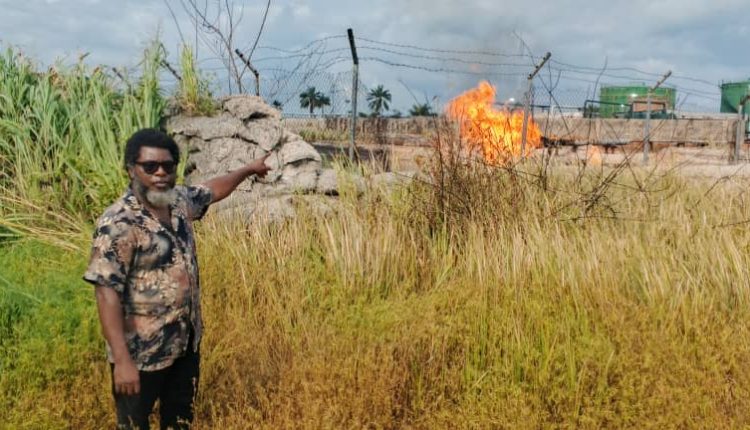
On the 22 of August, 2025, the Foundation for Earth Rights Assembly (FERA), embarked on a field trip to Ebedei Community in Ukwuani Local Government Area of Delta, Nigeria host to Platform/ Newcross Petroleum Ltd Flowstation/ Gas Compressor Station & PNG Gas Plant.
PNG GAS LIMITED(PNG), owner and operator of Egbaoma Gas Processing Plant(EGPP),located in Ebedei, Ukwuani LGA, and has a processing capacity of 30 million standard cubic feet of wet gas daily.
The PNG Gas’ facility is not different from the general practice in Nigeria with its tradition of oil production and exploration activities tend to characterise high flaring of gas due to inadequate infrastructure thereby leading to the excess gas being either incinerated at the top of towering stacks or openly on the ground.
On the dangers of gas flaring, we reached out to some residents of Ebedei community, host to Platform Petroleum Ltd subsidiary, PNG Gas, to ensure their voices as regards its gas flaring impacts on them are heard.
According to some natives of Ebedei community people comprising three young men, an elderly woman and a young lady when interviewed by the Foundation for Earth Rights Assembly’s (FERA) field monitors, they said since 2005 when Platform Petroleum Ltd started its operation at Ebedei, the community has had to put up continuously with gas flares burning continuously all day which threaten agricultural productivity and food security, particularly for vulnerable communities. The flares affect the rain water which used to be their major source of drinking water during the rainy season but it is no longer so because the black carbons from the flares fall on their roof tops which turn their rain water black. Consequently, the water can no longer serve the purpose which it used to serve them.
Apart from the heat continually generated by the flares, other problems associated with continued flaring of gas is the release of pollutants which result in acid rain, damage to soil fertility which totally undermine the health and sustainability of both local communities and ecosystems in the Niger Delta region.
Ebedei Community Grapples With Health Impacts Of Gas Flaring
The Foundation for Earth Rights Assembly’s(FERA) interviews with victims who are indigenes and whose major source of livelihood is farming provided insights into the challenges stemming from gas flaring in Ebedei community, host to PNG Gas Ltd.
Some of the women interviewed who depend on farming as their only source of livelihood, bemoaned poor yields of crops in their farms. They attributed some of the health challenges being faced to the gas flaring operations which are a few meters away from homes and farms.
The proximity has caused them difficulty in breathing and eye irritation.
Their experiences shed light on the widespread yet often neglected issue of gas flaring emblematic in Niger Delta region of Nigeria.
FERA’s investigation amongst the residents spoken to revealed links between the flaring activity and air pollution, which can result in physical discomfort and other health issues.
Scholarly articles have drawn correlations between gas flaring and some health problems ranging from respiratory diseases such as asthma, bronchitis, and lung cancer, cases of leukaemia, skin and eye irritation as well as the general feeling of discomfort widely reported.
Gas Flaring Is Illegal: The Case Of Iwherekan Community (Jonah V Shell)
In a landmark judgement delivered by the Learned trial Judge, Justice Nwokorie, of the Federal High Court, Benin City, on the 14Th November, 2005, His Lordship ruled and ordered that the 1st respondent (Shell Petroleum Development Company of Nigeria Ltd and the second respondent (Nigerian National Petroleum Corporation are accordingly restrained whether by themselves, their servants or workers or otherwise from further flaring of gas in Applicant’s community.
The case of Jonah Gbemre V. Shell Petroleum Development Company Nigeria Ltd. & 2 Ors., where the Plaintiff(Mr. Jonah Gbemre) for himself and as representing Iwherekan Community in Delta State, Nigeria, commenced action against Shell Petroleum Development Company Ldt. and Nigerian National Petroleum Corporation and the Attorney General of the Federation, wherein the following reliefs were sought:
a) A declaration that the Constitutionally guaranteed fundamental rights to life and dignity of human person provided in Sections 33(1) of the Constitution of the Federal Republic of Nigeria, 1999 and reinforced by Articles 4, 16 and 24 of the African Charter on Human and Peoples Rights(Ratification and Enforcement) Act, Cap A9, Vol.1. Laws of the Federation of Nigeria, 2004 inevitably includes the right to clean, poison-free, pollution-free and healthy environment.
b. A declaration that the actions of the first and second defendants in continuing to flare gas in the course of their oil exploration and production activities in the applicant’s community is a violation of their fundamental rights to life( including healthy environment) and dignity of human person guaranteed by Sections 33(1) and 34(1) of the Constitution of the Federal Republic of Nigeria, 1999 and reinforced by Articles 4, 16 and 24 of the African Charter on Human and Peoples Rights (Ratification and Enforcement) Act, Cap. A9 Vol. 1 Laws of the Federation of Nigeria, 2004.
c) A declaration that the failure of the first and second defendants to carry out environmental impact assessment in the applicant’s community concerning the effects of their gas flaring activities is a violation of Section 2(2) of the Environmental Impact Assessment Act, Cap. E12 Vol. 6 Laws of the Federation of Nigeria, 2004 and contributed to the violation of the applicant’s said fundamental rights to life and dignity of human person.
d) A declaration that the provisions of Section 3(2) (a) (b) of the Associated Gas Re-Injection Act, Cap. A25 Vol. 1 Laws of the Federation of Nigeria, 2004 and Section 1 of the Associated Gas Re-Injection (Continued Flaring of Gas) Regulations S. 1. 43 of 1984 under which continued flaring of gas in Nigeria may be allowed are inconsistent with the applicant’s rights to life and/ or dignity of human person enshrined in Sections 33(1) and 34(1) of the Constitution of the Federal Republic of Nigeria, 1999 and Articles 4, 16 and 24 of the African Charter on Human and Peoples Rights (Ratification and Enforcement) Act, Cap. A9 Vol. 1, Laws of the Federation of Nigeria, 2004 and are therefore unconstitutional, null and void by virtue of Section 1(3) of the same Constitution.
e) An ORDER of Perpetual Injunction restraining the first and second defendants by themselves or by their agents, servants, contractors or workers or otherwise howsoever from further flaring of gas in the applicant’s community.
Thus, individuals and communities can rely on the Charter to seek legal redress for environmental degradation, as seen in landmark cases such as Jonah Gbemre v. Shell Petroleum Development Company of Nigeria Ltd & Ors, where the Federal High Court upheld the right to a clean and healthy environment based on the combined force of the Constitution and the African Charter.
The provisions in the Constitution regarding environmental rights are complemented by its guarantees of fundamental human rights. Sections 33 and 34, which protect the rights to life and human dignity, have been argued to implicitly include the right to a safe, healthy, and pollution-free environment.
Nigeria’s Efforts Put In Place To Reduce Gas Flaring
Early oil and gas legislation—such as the Petroleum Act, 1969, and the Associated Gas Re-injection Act, 1979—included the prevention of atmospheric pollution and the conservation of resources. The Associated Gas Re-injection Act, 1979, prohibited gas flaring without the written permission of the minister in charge of oil and gas after January 1, 1984. However, measures to reduce flaring gained only limited traction, and the deadlines for ending routine flaring were repeatedly postponed.
In June 2016, Nigeria endorsed the World Bank’s Zero Routine Flaring by 2030 initiative.
Nigeria submitted its first Nationally Determined Contribution (NDC) to the United Nations Framework Convention on Climate Change in 2015. It included gas flaring reduction as a mitigation measure in its updated NDC, submitted in July 2021, where Nigeria commits to an unconditional reduction of 20 percent. The conditional reduction target is 47 percent. The update does not include unconditional contributions pertaining to the energy sector. Among the sector’s conditional contributions are zero routine flaring by 2030 and a 60 percent reduction in fugitive methane emissions by 2031.
In 2016, the government launched the Nigeria Gas Flare Commercialization Program (NGFCP), targeting 2020 as the year by which routine flaring would be ended. This target was not met. In 2018, the government issued the Flare Gas (Prevention of Waste and Pollution) Regulations, 2018, followed by four sets of associated guidelines and a reporting template. An important feature of the 2018 regulations was a marked increase in the flare payment rate. The 2018 regulations also provided a mechanism, similar to the one in Indonesia, for the government to take natural gas that would otherwise be flared and bid it out to third parties to commercialize it.
In December 2017, the Ministry of Petroleum Resources published the National Gas Policy in the official gazette. The policy commits the government to taking measures to ensure the development of flare capture and utilization projects and to work collaboratively with the industry, development partners, providers of flare-capture technologies, and third-party investors. The policy also points out that the gas flaring penalty (at the time equivalent to US$0.03/thousand standard cubic feet [mscf]) was too low to act as a disincentive (making it more economic to flare) and needed to be raised substantially. The annual Oil and Gas Industry Reports published by the Nigeria Extractive Industries Transparency Initiative (NEITI) show that, even at this very low penalty rate, some producers have not paid flaring penalties in full or at all.
In August 2021, former President Buhari signed the Petroleum Industry Act, 2021 (Petroleum Industry Act hereafter), an omnibus act covering the entire oil and gas value chain. Although it repealed some previous laws, such as the Associated Gas Re-injection Act, 1979, the Petroleum Industry Act considers most other laws and regulations equivalent to having been issued by the new regulators as long as their provisions are not inconsistent and until such a time as amendments to the new law repeals them. In particular, it retains the Petroleum Act, 1969, and several other laws until all licenses and leases signed under them are terminated. The Petroleum Industry Act contains five articles on gas flaring, promoting minimization of flaring and reinforcing the basic principles in the Flare Gas (Prevention of Waste and Pollution) Regulations, 2018. Gas Flaring, Venting and Methane Emissions (Prevention of Waste and Pollution) Regulations, 2023 (the Emissions Regulations hereafter) replaced the 2018 regulations.
The Associated Gas Re-injection (Continued Flaring of Gas) Regulations, 1984, set criteria for when flaring is allowed. No evidence of enforcement is available in the sources consulted. The National Effluent Limitation Regulation, 1991, issued by the Federal Environmental Protection Agency, placed limits on the concentrations of hydrocarbons in atmospheric emissions. According to Section 12.3 of the Emissions Regulations, the regulator will establish biannually the gas flaring threshold for licensees, lessees, and facilities.
The continued and unabated flaring of gas in Nigeria starkly illustrates what has been known for some time; flaring persists largely due to a lack of political will, commitment, and prioritization.
References
Jenigho Philip Esavwede and Ufuoma Garvin Oyibodoro, ‘Gas Flaring in Nigeria’s Niger Delta: Legal Challenges and Lessons from Norway’s Regulatory Framework’ (2025) 05 (01) Journal of Environmental Law & Policy 148-166, accessed on the 27 August, 2025 via: https://grassrootsjournals.org/jelp/jelp05.01.06-esavwede-oyibodoro.pdf
The Mail Newspaper-Gas flaring: Niger Delta communities suffer as oil giants pay nearly N500 billion in penalties Part 1- https://themail.com.ng/gas-flaring-niger-delta-communities-suffer-as-oil-giants-fail-to-pay-nearly-n500-billion-in-penalties-part-i/
Global Gas Flaring Tracker Report, July 2025
The World Bank: Global Methane and Flaring Regulations
